Safety Software Development and Integration
PLC safety programming and safety logic for industrial machines and production lines
Every safety function requires purpose-designed and verifiable logic
In automated machines and industrial production lines, safety functions must be implemented consistently with the control architecture and applicable regulatory requirements. Incomplete, non-integrated or incorrectly structured logic can compromise plant reliability and the long-term management of safety. The safety software development and integration service translates design requirements into safety-oriented control logic, correctly integrated into the machine’s automation systems.
When is it needed
This service is indicated when:
- Safety logic on Safety PLCs needs to be developed or updated;
- Work is being carried out on new, modified or revamped machines or lines;
- Safety functions need to be integrated into existing control architectures;
- Consistency is required between defined safety requirements and software implementation.

How the assessment is carried out
The safety software development activity includes:
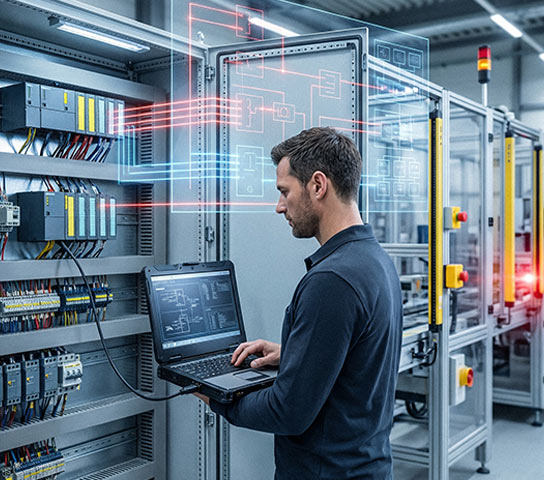
- System analysis and architecture: analysis of the required safety functions and definition of the Safety control system architecture, consistent with design and regulatory requirements.
- Safety PLC software development: programming of safety logic on certified PLCs and systems, with a safety-oriented approach and correct integration into the machine and plant architecture.
- Integration, commissioning support and putting into service: support for technical documentation, verification of the correct behaviour of safety functions and assistance during system testing and start-up phases.
NOTE: The development activity is carried out in continuity with the safety requirements defined at design level, maintaining a clear separation between analysis, implementation and verification.
What we deliver
- Safety PLC software developed and integrated into the control system;
- Safety logic consistent with applicable design and regulatory requirements;
- Technical support during testing and commissioning phases;
- Technical documentation to support the safety software.