Machinery safety standards
How the system works and what changes with Regulation 2023/1230
Safety standards are a technical reference
A manufacturer must place a new machine on the market. Designed, tested, operational. But how does it demonstrate, in a verifiable way and to anyone who inspects it, that the machine is safe?
Safety standards are the reference through which the obligation to build safe machinery is translated into verifiable technical requirements, and they are the foundation of CE conformity.
For machinery manufacturers and users, the applicable standards define the starting point of any safety project.
What a standard is: definitions and sources
Regulation (EU) 1025/2012 defines a standard as “a technical specification, adopted by a recognised standardisation body, for repeated or continuous application”. A technical instrument that operates within the framework of the law, taking up legal requirements and translating them into applicable criteria.
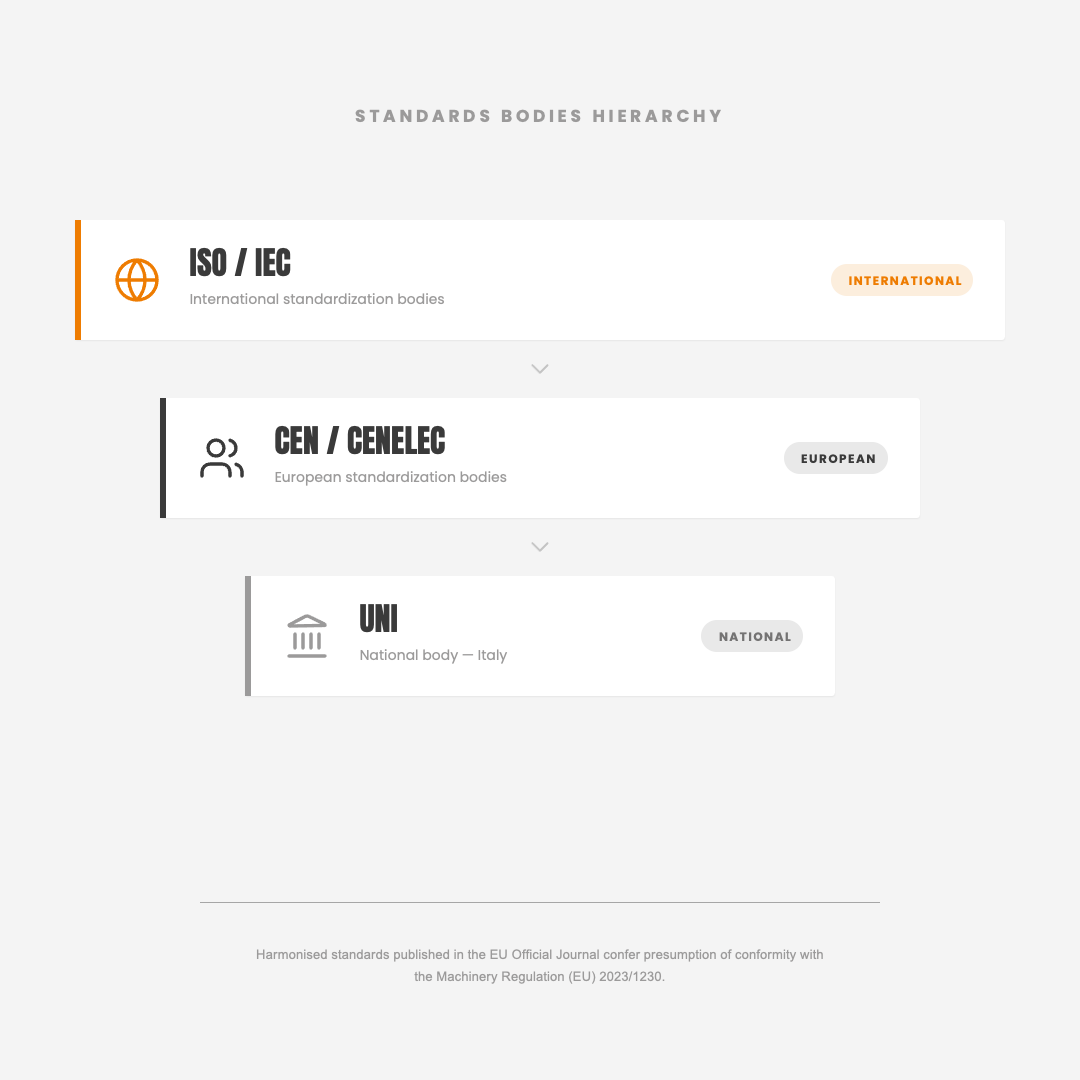
Standards are classified according to the body that adopts them:
- International standards: developed by standardisation bodies such as ISO and IEC
- European standards: developed by standardisation bodies such as CEN, CENELEC and ETSI
- Harmonised standards: standards published in the Official Journal of the EU; they confer a presumption of conformity with the Essential Health and Safety Requirements (EHSRs) of the Regulation, to the extent that those requirements are covered by the harmonised standard
- National standards: adopted by national bodies (UNI in Italy)
ISO (International Organization for Standardization) is the leading international standardisation body, present in 167 countries. In Italy, UNI (Ente Nazionale Italiano di Unificazione) represents ISO and takes part in CEN work at European level. IEC (International Electrotechnical Commission) is the leading international body for the preparation and publication of standards for all electrical, electronic and related technologies (such as IEC 62061 and IEC 60204-1). In Italy, CEI (Comitato Elettrotecnico Italiano) represents IEC and takes part in CENELEC work at European level.
The hierarchy of standards for machine safety
Machinery safety standards are structured across three levels: A, B and C.
Each level operates on a different plane of generality and specificity.
Type A, General principles.
- Standards on the fundamental concepts and general principles of safety design. They apply to any machine.
- Reference standard: EN ISO 12100:2010, Safety of machinery. General principles for design. Risk assessment and risk reduction.
Type B, Generic safety aspects.
- B1, specific aspects: they address a single safety characteristic applicable to several machines.
Examples: EN ISO 13857:2019 (safety distances), EN ISO 13850:2015 (emergency stop). - B2, protective devices: they address devices applicable to several categories of machines.
Examples: EN ISO 14120:2015 (guards), EN 60204-1:2018 (electrical equipment), EN ISO 13849-1:2023 (safety-related parts of control systems, PL), EN IEC 62061:2021 (functional safety, SIL).
Type C, Machine-specific standards.
- Detailed safety requirements for a machine or a category of machines. A type C standard takes precedence over type A and B standards, limited to the aspects it governs (EN ISO 12100).Example: EN ISO 10218-1:2025 Robotics, Safety requirements, Part 1: Industrial robots, and EN ISO 10218-2:2025 Robotics, Safety requirements, Part 2: Robot systems and integration.
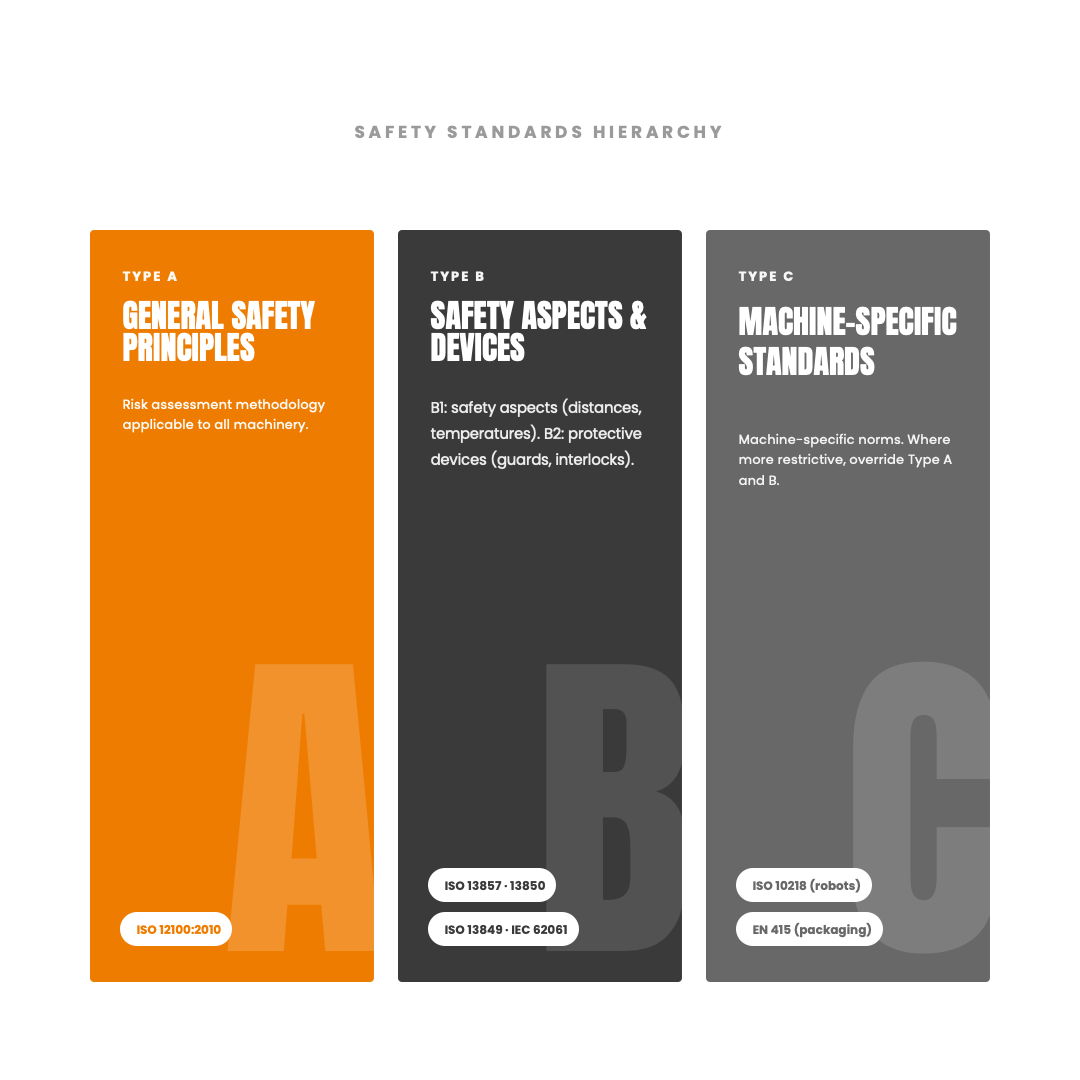
The starting point for any risk assessment is the type A standard: EN ISO 12100:2010 provides the iterative method to identify hazards, estimate and evaluate risk, and define reduction measures. Type B and C standards apply this method to specific contexts.
The Machinery Regulation (EU) 2023/1230: what changes
From Directive to Regulation: direct application across the EU
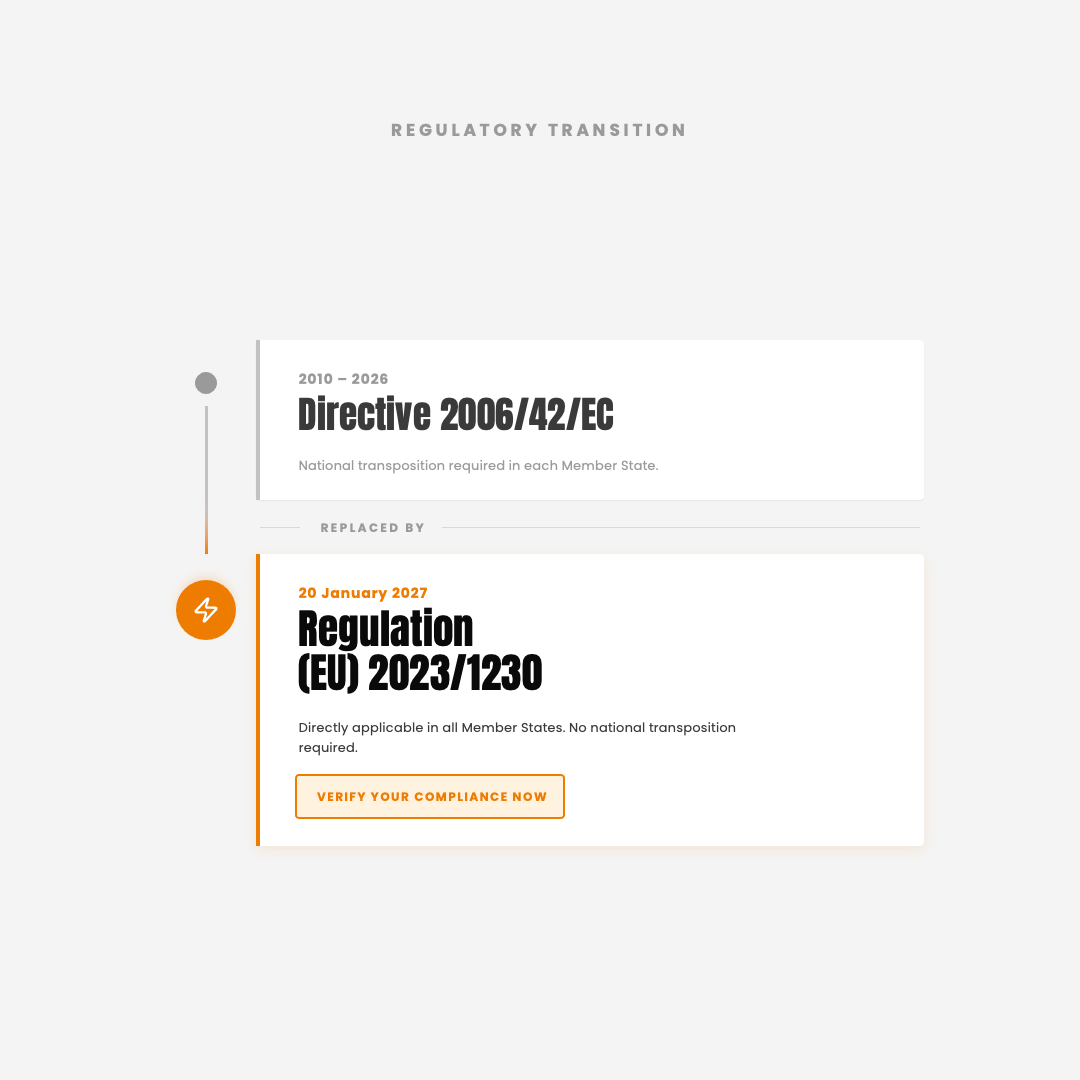
The Machinery Directive 2006/42/EC governed the design and marketing of machinery in the European Union for almost twenty years. It introduced CE marking as a conformity instrument and established the Essential Health and Safety Requirements (EHSRs), building a common regulatory framework for European manufacturers and users.
Regulation (EU) 2023/1230 replaces it with a structural change: whereas the Directive had to be transposed by the Member States, with possible national variations, the Regulation applies directly across the EU without transposition. A single regulatory version for all countries.
Date of application: 20 January 2027.
Until that date, Directive 2006/42/EC remains in force. From 20 January 2027, all new machinery placed on the market must comply with the requirements of the Regulation.
New obligations: manufacturers, importers, authorised representatives
The Regulation widens the range of parties involved.
Alongside the manufacturer, it introduces formal responsibilities for importers (verifying conformity before placing on the EU market), authorised representatives (the appointed representative of a non-EU manufacturer) and distributors (in certain circumstances).
The definition of substantial modification is updated: it explicitly includes modifications carried out “by physical or digital means”.
A software update that alters the behaviour of a safety system may constitute a substantial modification, and may result in the party carrying it out taking on the role of manufacturer of the modified machine under Regulation (EU) 2023/1230, with an obligation to carry out a new conformity assessment.
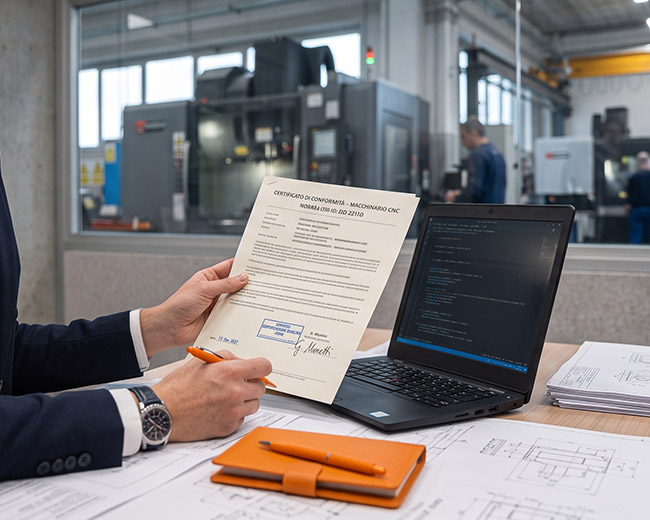
Software and connectivity as safety components
For the first time, the Regulation formalises specific requirements for software, connectivity and artificial intelligence.
The new EHSR 1.1.9 states that machinery must be protected against corruption via remote access or network connections.
Software performing safety functions enters Annex II as a safety component requiring CE marking.
Accessafe works where the standards are written
Our safety engineers take part in the standardisation groups UNI CT042/SC01/GL01 (Safety of machinery), UNI CT024/GL09 (Robots and robotic systems), ISO/TC 199 WG6 (Safety distances and ergonomic aspects) and CLC/TC 44X/WG2 (Protection against corruption, including cybersecurity aspects related to safety).
They know the content of the standards before publication and contribute to defining the requirements the market will have to meet.
Taking part in the international working groups allows our engineers to follow the evolution of the standards during their development, contributing to the technical discussion that precedes the publication of future editions.
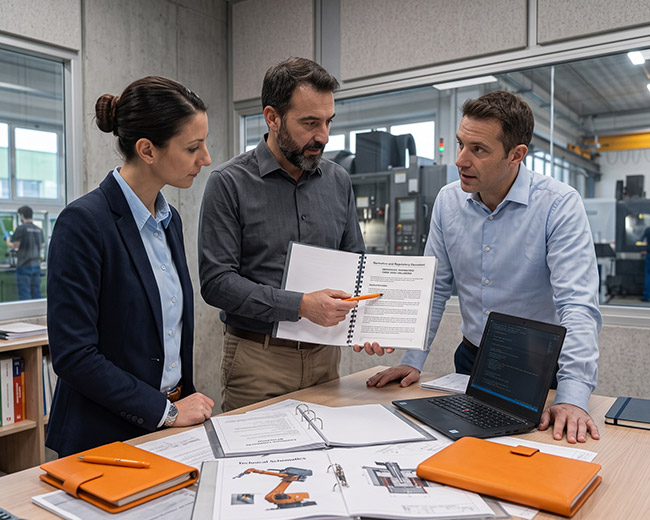
Accessafe support: from risk assessment to CE conformity
- Risk assessment (EN ISO 12100) / Hazard identification and definition of reduction measures for the specific machine.
- Verification of standard applicability / Which type C standards apply to the machine, which type B are relevant.
- Technical file and EC Declaration of Conformity / Structured documentation supporting CE marking.
- Analysis of conformity with Regulation (EU) 2023/1230 / For new machinery and for substantial modifications, including software-related ones.
- Machine Safety Lifecycle / Advice on managing the lifecycle of safety functions, after installation and over time.
Frequently asked questions
What is the difference between a standard and a regulation?
A standard is a technical specification produced by standardisation bodies (ISO, IEC, CEN, CENELEC, UNI, CEI) and applies on a voluntary basis. A regulation is a binding legal act issued by the EU.
Regulation (EU) 2023/1230 is binding and directly applicable in all Member States without transposition.
EN ISO standards are not, but when harmonised and applied they confer the presumption of conformity with the Regulation that references them.
Are EN ISO standards mandatory?
EN ISO standards always apply voluntarily. Even where they are referenced by a regulation they remain a technical instrument: it is the regulation that is binding, not the standard itself.
Harmonised standards, published in the Official Journal of the EU, do however have a special status: applying them confers the presumption of conformity with the requirements of the Regulation that references them.
Anyone who does not apply them can demonstrate conformity in another way, but must do so with explicit documentation.
What happens if I do not apply the harmonised standard?
The presumption of conformity no longer applies.
The manufacturer can place the machine on the market, but must demonstrate conformity with the Essential Health and Safety Requirements (EHSRs) of the Regulation using documented alternative methods.
In the event of an accident or inspection, the burden of proof is heavier. Applying harmonised standards reduces legal risk and simplifies the certification process.
Can a software modification be a substantial modification?
Yes, from 20 January 2027. Regulation (EU) 2023/1230 explicitly includes modifications carried out “by physical or digital means” in the definition of substantial modification.
A software update that alters the behaviour of a safety system, for example a PLC managing emergency stop functions, may require a new conformity assessment and, in some cases, new CE marking.
In these cases the party carrying out the modification may take on the role of manufacturer of the modified machine.
What changes for machinery already in use after 2027?
Machinery already installed and compliant with Directive 2006/42/EC does not have to be automatically brought into line with Regulation 2023/1230.
The Regulation applies to new machinery placed on the market after 20 January 2027 and to machinery that undergoes a substantial modification after that date.
Anyone buying or putting into service a used machine after 2027 must verify conformity with the regulatory framework in force at the time of its original placing on the market.
Where do you start to know which standard applies to your machine?
The starting point is always the type A standard: EN ISO 12100:2010, which defines the risk assessment method applicable to any machine. From there you check whether a specific type C standard exists for the machine category: if so, it prevails over A and B.
In the absence of a type C standard, you identify the relevant type B standards for the specific aspects (safety distances, guards, control systems).
For complex machines or those with digital components, specialist advice reduces time and margins of error.